The portraits of Goya in the Casa de Alba: art and history in the Liria Palace
The artistic collection of the Casa de Alba constitutes one of the most important private assets in Europe. Within the wealth of funds that houses the Liria Palace, the figure of Francisco de Goya occupies a central place, not only because of the technical quality of his canvases, but also because of the historical testimony they represent. Los Goya's paintings in Madrid they find in this palace a unique context, where the work of art is integrated into the space for which, in many cases, it was conceived.
The presence of Goya at the Liria Palace allows the visitor to understand the evolution of Spanish portraiture at the end of the 18th century. The Aragonese artist was able to accurately capture the physiognomy and social position of the members of the Alba family, establishing a standard of excellence in Pinacoteca Casa de Alba which has endured over the centuries.
The close relationship between Francisco de Goya and the Casa de Alba
Francisco de Goya's relationship with the Casa de Alba began in the last decade of the 18th century. In 1794, the artist already enjoyed a consolidated prestige in the court of Carlos IV, which led to his approach to the main families of the aristocracy. However, his relationship with the Alba family was especially prolific and close, moving away from the strict conventionalism of the time.
The epicenter of this link was María del Pilar Teresa Cayetana de Silva, XIII Duchess of Alba. Goya was not only his chamber painter, but he became part of his most intimate environment. This trust resulted in a series of commissions that allowed the painter to experiment with new forms of representation, giving his models a psychological depth that until then was unusual in Spanish noble portraiture. The correspondence and testimonies of the time confirm that Goya spent time in the family's residences, allowing him to observe and capture the daily life and personality of his protectors with exceptional realism.
Goya's masterpieces in the Liria Palace collection
La Pinacoteca Casa de Alba It houses pieces that are fundamental to understanding Goya's trajectory. Despite the transfers and the historical vicissitudes that have affected the collection, including the reconstruction of the palace after the Civil War, the works of the Aragonese master remain the fundamental pillars of the exhibition itinerary. The case of the portrait of Marquise de Lazán, is a good example of the latter. Made in 1804, it shows the painter's extensive creative experience, and is presented in front of The Duchess of Alba in white in the Goya room, allowing visitors to compare the technique and symbolism of Francisco de Goya in these two large portraits.
These works are not only objects of aesthetic contemplation, but historical documents that narrate the transition from Neoclassicism to creative freedom closer to Romanticism. When analyzing the specimens of Goya at the Liria Palace, there is a technical mastery in the treatment of tissues, light and, above all, the expression of faces, which give those portrayed an almost tangible presence.
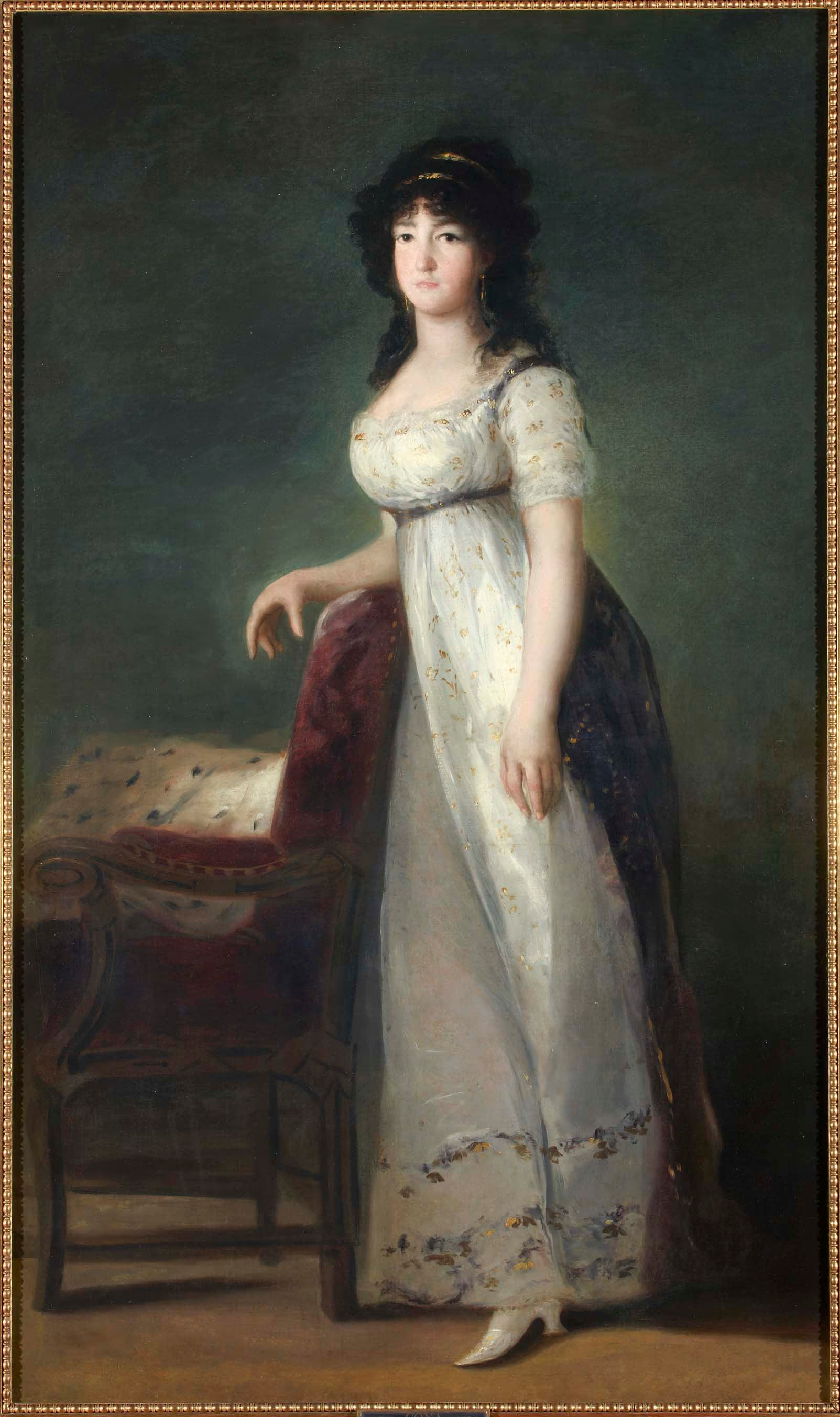
The portrait of the XIII Duchess of Alba in white: elegance and magnetism
Without a doubt, the most emblematic piece in the collection is the Portrait of the Duchess of Alba in white, painted in 1795. In this work, Goya presents the Duchess in a simple but sophisticated outfit, characteristic of late 18th century fashion. The use of white in the dress, which dominates the composition, highlights the figure against the landscape background, while the red details (the ribbon at the waist and chest) provide a rigorous chromatic balance.
From a technical point of view, the painting stands out for its loose brushstroke and Goya's ability to reproduce textures. The Duchess appears in a firm stance, pointing to the floor where the artist has inscribed his signature, which underlines the importance of the painter in the house. El Portrait of the Duchess of Alba in white It is a key work within the Goya's paintings in Madrid, representing a milestone in the history of female portraiture due to its combination of aristocratic dignity and naturalness.
Other family portraits: the Marquis de Villafranca and the Duchess of Berwick
In addition to the famous portrait of the XIII Duchess, the collection has other valuable representations. A notable example is the portrait of Francisco de Borja Álvarez de Toledo, Marquis of Villafranca and Duke consort of Alba. In this work, Goya opts for a more sober and restrained representation, focusing on the intellectual facet of the duke, who appears surrounded by elements that allude to his interest in music and culture.
In addition, the portraits of other members of the family, such as those linked to the Berwick line, allow us to observe Goya's versatility in adapting to different personalities. Each canvas in the Pinacoteca Casa de Alba has been the subject of technical studies and restorations that ensure its conservation, allowing visitors to appreciate the evolution of the painter's style, from its most polished finishes to its most expressive and modern techniques.
The influence of Goya's style on the Casa de Alba art gallery
Goya's imprint on the Casa de Alba collection transcends his own paintings. His genius established a level of quality that served as a reference for the family's subsequent acquisitions and commissions. The art gallery, which houses works by Titian, Rubens, Rembrandt and Velázquez, finds in Goya the link between the tradition of the great European masters and pictorial modernity.
The interest of the successive Dukes of Alba in maintaining and expanding this legacy has allowed the Liria Palace to be today an international reference for the study of Spanish painting. Goya's influence can be seen in the layout of the rooms and in the coherence of a collection that, despite its diversity, maintains a constant dialogue with the figure of the Aragonese painter. His ability to capture the essence of nobility without sacrificing human truth remains the standard by which the historical value of the art gallery is measured.
How to visit Goya's paintings in the Liria Palace
To get to know these masterpieces up close, the Liria Palace offers a system of guided tours that allow access to the main rooms of the residence. Unlike a traditional museum, here Goya's works are exhibited in the original palatial environment, surrounded by period furniture and decorative arts that enrich the visitor's experience.
The visit allows not only to admire the Goya's paintings in Madrid, but also to explore the history of Spain through one of its most illustrious noble houses.
If you want to delve deeper into this artistic legacy and personally contemplate the portraits that defined an era, you can manage your entry through the following link:
Book your visit to the Liria Palace
.svg)


